1D RM-Synthesis
[1]:
from __future__ import annotations

import astropy.units as u
import matplotlib.pyplot as plt
import numpy as np
from astropy.visualization import quantity_support
from rm_lite.tools_1d import rmsynth

plt.rcParams["figure.dpi"] = 150

_ = quantity_support()
rng = np.random.default_rng(42)
First generate some synthetic data
[2]:
from rm_lite.utils.simulate import faraday_simple_spectrum, faraday_slab_spectrum
from rm_lite.utils.synthesis import freq_to_lambda2
Here we’ll simulate RACS-all frequency coverage
[3]:
bw_low = 288
bw_mid = 144
bw_high = 288
low = np.linspace(943.5 - bw_low / 2, 943.5 + bw_low / 2, 36) * u.MHz
mid = np.linspace(1367.5 - bw_mid / 2, 1367.5 + bw_mid / 2, 9) * u.MHz
high = np.linspace(1655.5 - bw_high / 2, 1655.5 + bw_high / 2, 9) * u.MHz
freqs = np.concatenate([low, mid, high])
freq_hz = freqs.to(u.Hz).value
Now we make a Faraday simple spectrum with a single RM component. We will use the following parameters:
[4]:
delta_rm_radm2 = 30
rm_radm2 = 100
frac_pol = 0.5
psi0_deg = 10
complex_data_noiseless = faraday_simple_spectrum(
    freq_to_lambda2(freq_hz),
    frac_pol=frac_pol,
    psi0_deg=psi0_deg,
    rm_radm2=rm_radm2,
)
[5]:
fig, ax = plt.subplots()
ax.plot(
    freq_hz, np.real(complex_data_noiseless), ".", label="Stokes Q", color="tab:red"
)
ax.plot(
    freq_hz, np.imag(complex_data_noiseless), ".", label="Stokes U", color="tab:blue"
)
ax.legend()
ax.set(
    xlabel=rf"$\nu$ / {u.Hz:latex_inline}",
    ylabel="Flux density",
    title="Stokes Q and U",
)
[5]:
[Text(0.5, 0, '$\\nu$ / $\\mathrm{Hz}$'),
 Text(0, 0.5, 'Flux density'),
 Text(0.5, 1.0, 'Stokes Q and U')]
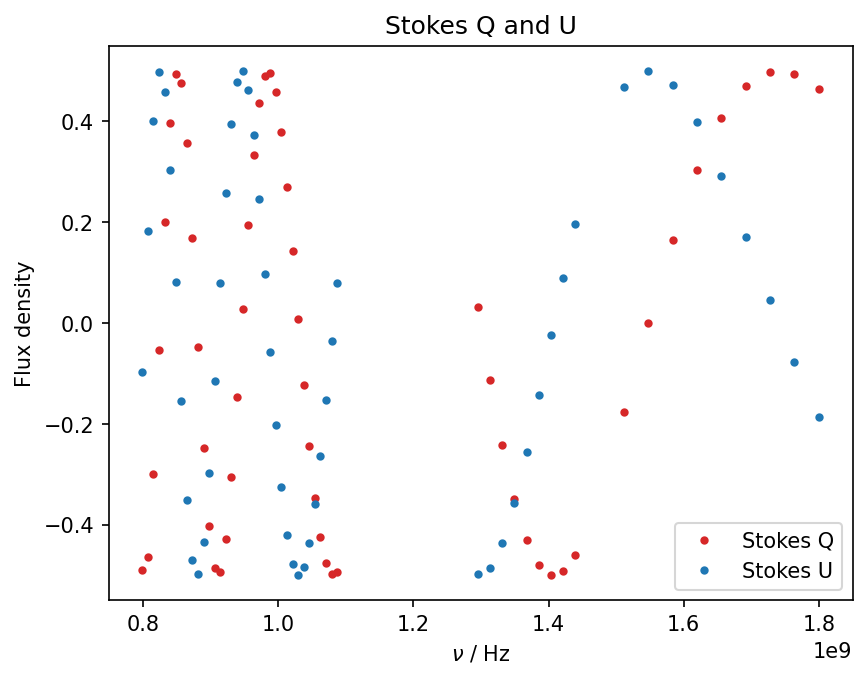
Now we can run RM-synthesis by calling rmsynth.run_rmsynth
[6]:
help(rmsynth.run_rmsynth)
Help on function run_rmsynth in module rm_lite.tools_1d.rmsynth:

run_rmsynth(freq_arr_hz: 'NDArray[np.float64]', complex_pol_arr: 'NDArray[np.complex128]', complex_pol_error: 'NDArray[np.complex128]', stokes_i_arr: 'NDArray[np.float64] | None' = None, stokes_i_error_arr: 'NDArray[np.float64] | None' = None, stokes_i_model_arr: 'NDArray[np.float64] | None' = None, stokes_i_model_error: 'NDArray[np.float64] | None' = None, phi_max_radm2: 'float | None' = None, d_phi_radm2: 'float | None' = None, n_samples: 'float | None' = 10.0, weight_type: 'WeightType' = 'variance', robust: 'float | None' = None, do_fit_rmsf: 'bool' = False, do_fit_rmsf_real: 'bool' = False, fit_function: "Literal['log', 'linear']" = 'log', fit_order: 'int' = 2, ignore_stokes_i: 'bool' = False, moment_threshold_snr: 'float' = 5.0) -> 'RMSynth1DResults'
    Run RM-synthesis on 1D data

    Args:
        freq_arr_hz (NDArray[np.float64]): Frequencies in Hz
        complex_pol_arr (NDArray[np.complex128]): Complex polarisation values (Q + iU)
        complex_pol_error (NDArray[np.float64]): Complex polarisation errors (dQ + idU)
        stokes_i_arr (NDArray[np.float64] | None, optional): Total itensity values. Defaults to None.
        stokes_i_error_arr (NDArray[np.float64] | None, optional): Total intensity errors. Defaults to None.
        stokes_i_model_arr (NDArray[np.float64] | None, optional): Total intensity model array. Defaults to None.
        stokes_i_model_error (NDArray[np.float64] | None, optional): Total intensity model error. Defaults to None.
        phi_max_radm2 (float | None, optional): Maximum Faraday depth. Defaults to None.
        d_phi_radm2 (float | None, optional): Spacing in Faraday depth. Defaults to None.
        n_samples (float | None, optional): Number of samples across the RMSF. Defaults to 10.0.
        weight_type (WeightType, optional): Weighting: 'variance' (1/sigma^2), 'uniform' (equal per channel), 'uniform_lsq' (equal per lambda^2 interval, narrows the RMSF), 'briggs' (robust). Defaults to "variance".
        robust (float | None, optional): Briggs robust parameter, required for weight_type='briggs'. Defaults to None.
        do_fit_rmsf (bool, optional): Fit the RMSF main lobe. Defaults to False.
        do_fit_rmsf_real (bool, optional): Fit only the real part of the RMSF. Defaults to False.
        fit_function ("log" | "linear", optional): RMSF fit function. Defaults to "log".
        fit_order (int, optional): Polynomial fit order. Defaults to 2. Negative values will iterate until the fit is good.
        moment_threshold_snr (float, optional): SNR cut (times the theoretical FDF noise) applied to FDF amplitudes before computing the Faraday moments. Defaults to 5.0.

    Returns:
        RMSynth1DResults:
            fdf_parameters (pl.DataFrame): FDF parameters
            fdf_arrs (pl.DataFrame): RMSynth arrays
            rmsf_arrs (pl.DataFrame): RMSF arrays
[7]:
fdf_parameters, fdf_arrs, rmsf_arrs, stokes_i_arrs = rmsynth.run_rmsynth(
    freq_arr_hz=freq_hz,
    complex_pol_arr=complex_data_noiseless,
    complex_pol_error=np.zeros_like(complex_data_noiseless),
    do_fit_rmsf=True,
    n_samples=100,
)
WARNING rmsynth.run_rmsynth: Stokes I array/errors or model not provided. No fractional polarization will be calculated.
INFO synthesis.rmsynth_nufft: Running RM-synthesis using the NUFFTs over 2001 Faraday depth channels.
INFO synthesis.rmsynth_nufft: NUFFT complete in 0.0038 seconds.
INFO synthesis.get_rmsf_nufft: Fitting main lobe in each RMSF spectrum.
INFO rmsynth._run_rmsynth: RM-synthesis completed in 14.16ms.
The output values are Polars dataframes that can be inspected easily
[8]:
fdf_parameters
[8]:
| fdf_error_mad | peak_pi_fit | peak_pi_error | peak_pi_fit_debias | peak_pi_fit_snr | peak_pi_fit_index | peak_rm_fit | peak_rm_fit_error | peak_q_fit | peak_u_fit | peak_pa_fit_deg | peak_pa_fit_deg_error | peak_pa0_fit_deg | peak_pa0_fit_deg_error | fit_function | lam_sq_0_m2 | ref_freq_hz | fwhm_rmsf_radm2 | phi_max_scale_radm2 | fdf_error_noise | fdf_q_noise | fdf_u_noise | min_freq_hz | max_freq_hz | n_channels | median_d_freq_hz | frac_pol | frac_pol_error | sigma_add | sigma_add_minus | sigma_add_plus | mom0 | mom0_debias | mom1_radm2 | mom2_radm2 | moment_threshold_snr |
|---|---|---|---|---|---|---|---|---|---|---|---|---|---|---|---|---|---|---|---|---|---|---|---|---|---|---|---|---|---|---|---|---|---|---|---|
| f64 | f64 | f64 | f64 | f64 | i64 | f64 | f64 | f64 | f64 | f64 | f64 | f64 | f64 | str | f64 | f64 | f64 | f64 | f64 | f64 | f64 | f64 | f64 | i64 | f64 | f64 | f64 | f64 | f64 | f64 | f64 | f64 | f64 | f64 | f64 |
| NaN | 0.500279 | 0.0 | 0.500279 | inf | 1296 | 99.999904 | 0.0 | -0.202569 | -0.457124 | 123.050018 | 0.0 | 10.000452 | 0.0 | "log" | 0.082563 | 1.0433e9 | 34.522155 | 113.191071 | 0.0 | 0.0 | 0.0 | 7.995e8 | 1.7995e9 | 54 | 8.2286e6 | NaN | NaN | NaN | NaN | NaN | 1.346747 | 1.346747 | 69.386287 | 138.885199 | 5.0 |
[9]:
fdf_arrs
[9]:
| phi_arr_radm2 | fdf_dirty_complex_arr |
|---|---|
| f64 | object |
| -336.725921 | (-0.012941952987807103+0.005575905271668905j) |
| -336.389195 | (-0.013584447466549732+0.005189884663585659j) |
| -336.052469 | (-0.014213132463713843+0.004794461009568579j) |
| -335.715743 | (-0.01482712771337132+0.004389828120960796j) |
| -335.379017 | (-0.015425552941836488+0.003976168117102392j) |
| … | … |
| 335.379017 | (-0.0009008057626928257+0.008053597616970908j) |
| 335.715743 | (-0.0009576261370891269+0.007885479952290737j) |
| 336.052469 | (-0.0009822552939409935+0.007717971936861509j) |
| 336.389195 | (-0.0009751402168175126+0.007551392504192875j) |
| 336.725921 | (-0.0009367721104613681+0.007386049740302505j) |
[10]:
rmsf_arrs
[10]:
| phi2_arr_radm2 | rmsf_complex_arr |
|---|---|
| f64 | object |
| -673.788568 | (-0.0329575974415113-0.0360831117177476j) |
| -673.451842 | (-0.032467101832120024-0.03631435677037289j) |
| -673.115116 | (-0.03194042093852627-0.036538602915399204j) |
| -672.77839 | (-0.03137760921834162-0.03675582151570247j) |
| -672.441664 | (-0.030778770230473887-0.03696597750309249j) |
| … | … |
| 672.441664 | (-0.030778770230891164+0.036965977502953294j) |
| 672.77839 | (-0.031377609218734684+0.036755821515558944j) |
| 673.115116 | (-0.031940420938894855+0.03653860291525102j) |
| 673.451842 | (-0.03246710183246473+0.03631435677022105j) |
| 673.788568 | (-0.03295760578020578+0.03608308730681604j) |
Since we provided no Stokes \(I\) data, the stokes I model will just be unity with 0 error. The flag_arr array tells us which channels were not used in RM-synthesis or model fitting
[11]:
stokes_i_arrs
[11]:
| freq_arr_hz | lambda_sq_arr_m2 | stokes_i_model_arr | stokes_i_model_error | flag_arr | complex_pol_arr | complex_pol_error |
|---|---|---|---|---|---|---|
| f64 | f64 | f64 | f64 | bool | object | object |
| 7.995e8 | 0.140606 | null | null | true | (-0.49042944532403415-0.09735994638022451j) | 0j |
| 8.0773e8 | 0.137756 | null | null | true | (-0.4654241884816873+0.18270283187778674j) | 0j |
| 8.1596e8 | 0.134992 | null | null | true | (-0.3001379571186853+0.3998964949791661j) | 0j |
| 8.2419e8 | 0.13231 | null | null | true | (-0.053617325136419355+0.497116870006657j) | 0j |
| 8.3241e8 | 0.129707 | null | null | true | (0.20074123829142537+0.45793335240974226j) | 0j |
| … | … | … | … | … | … | … |
| 1.6555e9 | 0.032793 | null | null | true | (0.4056251419940925+0.29234952399871j) | 0j |
| 1.6915e9 | 0.031412 | null | null | true | (0.46997598588767076+0.17065336998990638j) | 0j |
| 1.7275e9 | 0.030117 | null | null | true | (0.49801253407054746+0.04453668048509923j) | 0j |
| 1.7635e9 | 0.0289 | null | null | true | (0.49406601726750204-0.07680345422849415j) | 0j |
| 1.7995e9 | 0.027755 | null | null | true | (0.463743096038396-0.1869287053309979j) | 0j |
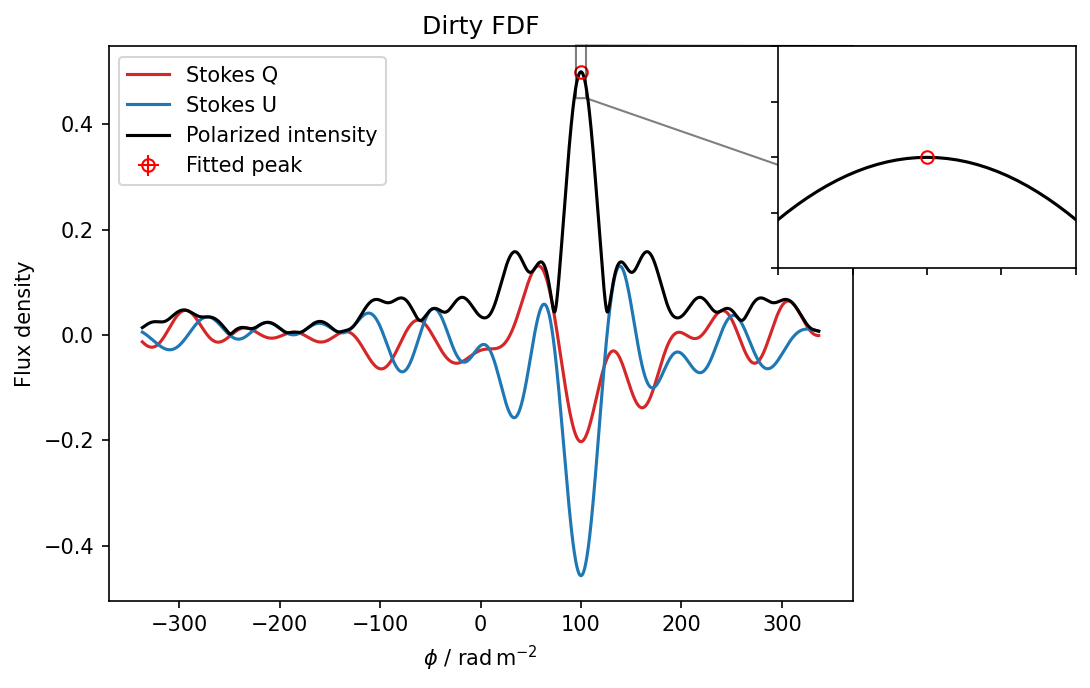
We can also easily visualise the data
[12]:
phi_arr_radm2 = fdf_arrs["phi_arr_radm2"].to_numpy()
fdf_dirty_arr = fdf_arrs["fdf_dirty_complex_arr"].to_numpy().astype(complex)

fig, ax = plt.subplots()
x1, x2, y1, y2 = 95, 105, 0.45, 0.55  # subregion of the original image
axins = ax.inset_axes(
    (0.9, 0.6, 0.4, 0.4), xlim=(x1, x2), ylim=(y1, y2), xticklabels=[], yticklabels=[]
)
for _ax in [ax, axins]:
    _ax.plot(
        phi_arr_radm2,
        fdf_dirty_arr.real,
        color="tab:red",
        label="Stokes Q",
    )
    _ax.plot(
        phi_arr_radm2,
        fdf_dirty_arr.imag,
        color="tab:blue",
        label="Stokes U",
    )
    _ax.plot(
        phi_arr_radm2,
        np.abs(fdf_dirty_arr),
        color="k",
        label="Polarized intensity",
    )

    _ax.errorbar(
        fdf_parameters["peak_rm_fit"],
        fdf_parameters["peak_pi_fit"],
        xerr=fdf_parameters["peak_rm_fit_error"],
        yerr=fdf_parameters["peak_pi_error"],
        fmt="o",
        lw=1,
        color="red",
        mfc="none",
        label="Fitted peak",
    )

ax.set(
    xlabel=rf"$\phi$ / {u.rad / u.m**2:latex_inline}",
    ylabel="Flux density",
    title="Dirty FDF",
    # xlim=[50, 150],
)
ax.indicate_inset_zoom(axins, edgecolor="black")
ax.legend()
[12]:
<matplotlib.legend.Legend at 0x7d13a1d29460>
[13]:
phi2_arr_radm2 = rmsf_arrs["phi2_arr_radm2"].to_numpy()
rmsf_arr = rmsf_arrs["rmsf_complex_arr"].to_numpy().astype(complex)

fig, ax = plt.subplots()
ax.plot(
    phi2_arr_radm2,
    rmsf_arr.real,
    color="tab:red",
    label="Stokes Q",
)
ax.plot(
    phi2_arr_radm2,
    rmsf_arr.imag,
    color="tab:blue",
    label="Stokes U",
)
ax.plot(
    phi2_arr_radm2,
    np.abs(rmsf_arr),
    color="k",
    label="Polarized intensity",
)
ax.legend()
ax.set(
    xlabel=rf"$\phi$ / {u.rad / u.m**2:latex_inline}",
    ylabel="RMSF",
    title="RMSF",
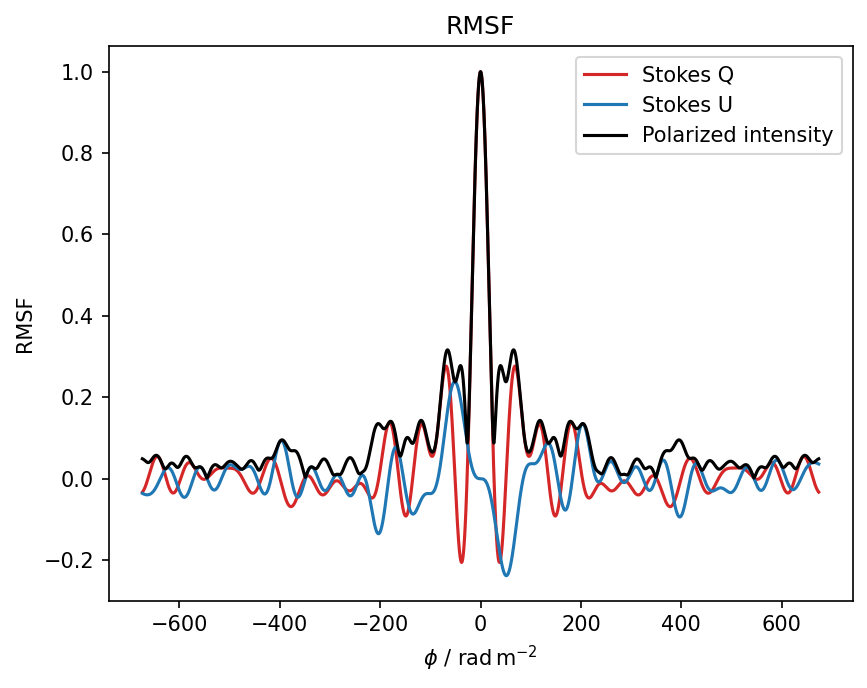
)
[13]:
[Text(0.5, 0, '$\\phi$ / $\\mathrm{rad\\,m^{-2}}$'),
 Text(0, 0.5, 'RMSF'),
 Text(0.5, 1.0, 'RMSF')]
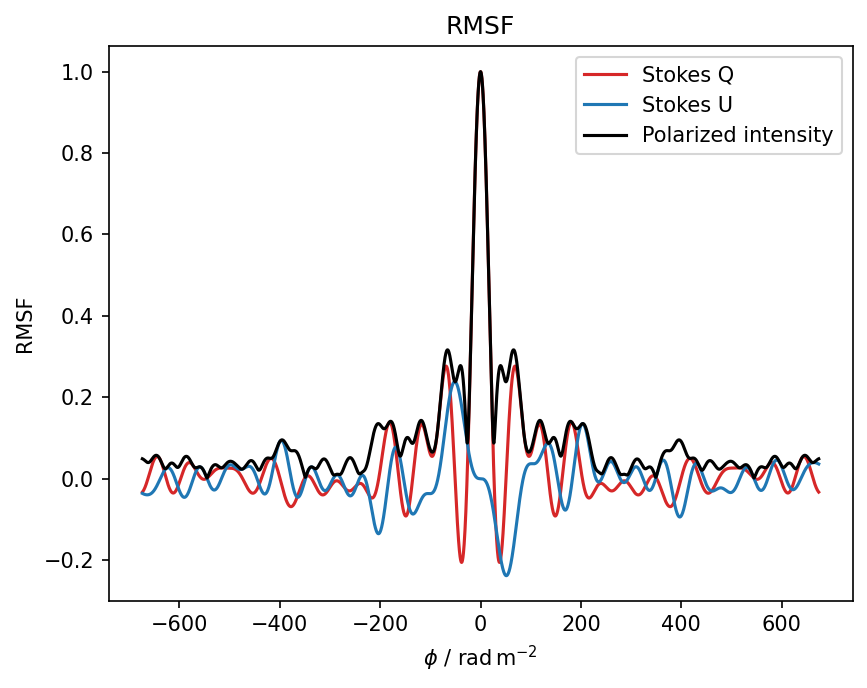
Now lets do a more complex example. We’ll add noise and a Stokes \(I\) spectrum
[14]:
from rm_lite.utils.fitting import power_law
[15]:
delta_rm_radm2 = 30
rm_radm2 = 100
frac_pol = 0.5
psi0_deg = 10
complex_data_noiseless = faraday_slab_spectrum(
    freq_to_lambda2(freq_hz),
    frac_pol=frac_pol,
    psi0_deg=psi0_deg,
    rm_radm2=rm_radm2,
    delta_rm_radm2=delta_rm_radm2,
)


stokes_i_flux = 1.0
spectral_index = -0.7
rms_noise = 0.1


stokes_i_model = power_law(order=1)
stokes_i_noiseless = stokes_i_model(
    freq_hz / (np.mean(freq_hz)), stokes_i_flux, spectral_index
)
stokes_i_noise = rng.normal(0, rms_noise, size=freq_hz.size)
stokes_i_noisy = stokes_i_noiseless + stokes_i_noise


stokes_q_noise = rng.normal(0, rms_noise, size=freq_hz.size)
stokes_u_noise = rng.normal(0, rms_noise, size=freq_hz.size)
complex_noise = stokes_q_noise + 1j * stokes_u_noise

complex_flux = complex_data_noiseless * stokes_i_noiseless
complex_data_noisy = complex_data_noiseless + complex_noise
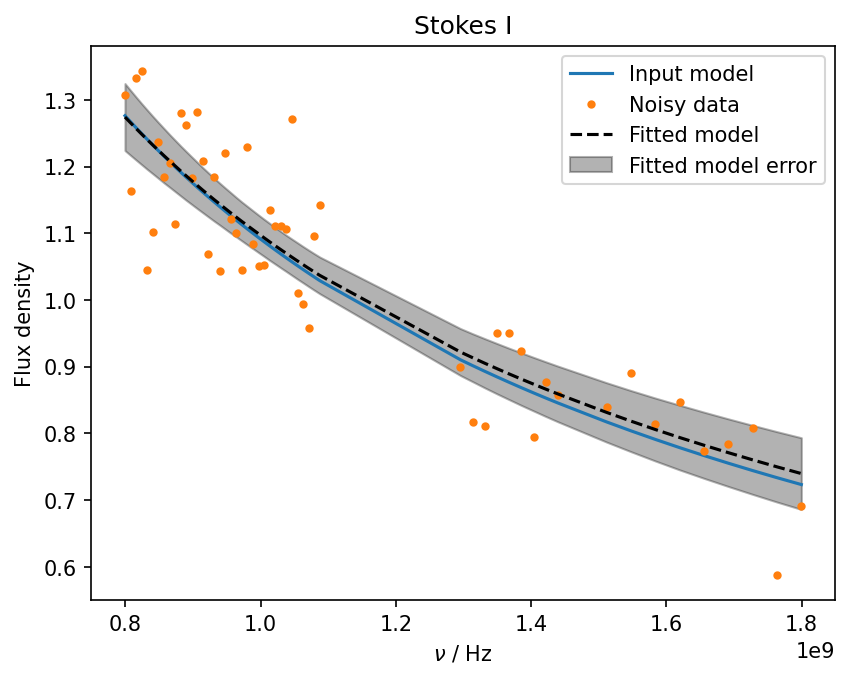
Now we enable Stokes \(I\) model fitting through providing the data, and enabling fit_order. If fit_order<0 an iterative fit will be performed.
[16]:
fdf_parameters, fdf_arrs, rmsf_arrs, stokes_i_arrs = rmsynth.run_rmsynth(
    freq_arr_hz=freq_hz,
    complex_pol_arr=complex_data_noisy,
    complex_pol_error=np.ones_like(complex_data_noiseless)
    * (rms_noise + rms_noise * 1j),
    stokes_i_arr=stokes_i_noisy,
    stokes_i_error_arr=np.ones_like(stokes_i_noisy) * rms_noise,
    do_fit_rmsf=True,
    n_samples=100,
    fit_order=-3,
)
INFO synthesis.create_fractional_spectra: Fitting Stokes I model to calculate fractional spectra.
INFO fitting.dynamic_fit: Iteratively fitting Stokes I model of type log with max order 3.
INFO fitting.static_fit: Fitting Stokes I model of type log with order 0.
INFO fitting.static_fit: Fit results: ['1.04 +/- 0.0136']
INFO fitting.static_fit: Fitting Stokes I model of type log with order 1.
INFO fitting.static_fit: Fit results: ['1.07 +/- 0.0138', '-0.671 +/- 0.0608']
INFO fitting.static_fit: Fitting Stokes I model of type log with order 2.
INFO fitting.static_fit: Fit results: ['1.08 +/- 0.0205', '-0.62 +/- 0.0835', '-0.593 +/- 0.672']
INFO fitting.static_fit: Fitting Stokes I model of type log with order 3.
INFO fitting.static_fit: Fit results: ['1.08 +/- 0.0212', '-0.62 +/- 0.127', '-0.589 +/- 1.1', '-0.0254 +/- 6.9']
INFO fitting.dynamic_fit: Fit results for orders [0 1 2 3]:
INFO fitting.dynamic_fit: Best fit found with 2 parameters.
INFO synthesis.rmsynth_nufft: Running RM-synthesis using the NUFFTs over 2001 Faraday depth channels.
INFO synthesis.rmsynth_nufft: NUFFT complete in 0.00256 seconds.
INFO synthesis.get_rmsf_nufft: Fitting main lobe in each RMSF spectrum.
INFO rmsynth._run_rmsynth: RM-synthesis completed in 7.87ms.
[17]:
fdf_parameters
[17]:
| fdf_error_mad | peak_pi_fit | peak_pi_error | peak_pi_fit_debias | peak_pi_fit_snr | peak_pi_fit_index | peak_rm_fit | peak_rm_fit_error | peak_q_fit | peak_u_fit | peak_pa_fit_deg | peak_pa_fit_deg_error | peak_pa0_fit_deg | peak_pa0_fit_deg_error | fit_function | lam_sq_0_m2 | ref_freq_hz | fwhm_rmsf_radm2 | phi_max_scale_radm2 | fdf_error_noise | fdf_q_noise | fdf_u_noise | min_freq_hz | max_freq_hz | n_channels | median_d_freq_hz | frac_pol | frac_pol_error | sigma_add | sigma_add_minus | sigma_add_plus | mom0 | mom0_debias | mom1_radm2 | mom2_radm2 | moment_threshold_snr |
|---|---|---|---|---|---|---|---|---|---|---|---|---|---|---|---|---|---|---|---|---|---|---|---|---|---|---|---|---|---|---|---|---|---|---|---|
| f64 | f64 | f64 | f64 | f64 | i64 | f64 | f64 | f64 | f64 | f64 | f64 | f64 | f64 | str | f64 | f64 | f64 | f64 | f64 | f64 | f64 | f64 | f64 | i64 | f64 | f64 | f64 | f64 | f64 | f64 | f64 | f64 | f64 | f64 | f64 |
| NaN | 0.204894 | 0.01459 | 0.203696 | 14.043864 | 1265 | 89.364055 | 1.229083 | -0.198363 | -0.050445 | 97.134084 | 2.039887 | 34.397406 | 11.808332 | "log" | 0.082563 | 1.0433e9 | 34.522155 | 113.191071 | 0.01459 | 0.01461 | 0.014569 | 7.995e8 | 1.7995e9 | 54 | 8.2286e6 | 0.191109 | 0.013688 | 2.053029 | 1.584966 | 2.533219 | 0.623978 | 0.614144 | 115.404973 | 58.706994 | 5.0 |
[18]:
fdf_arrs
[18]:
| phi_arr_radm2 | fdf_dirty_complex_arr |
|---|---|
| f64 | object |
| -336.725921 | (-0.014737349935157283+0.009365828725447037j) |
| -336.389195 | (-0.015268595888951995+0.009364196871523149j) |
| -336.052469 | (-0.015792726350951483+0.009354890832883432j) |
| -335.715743 | (-0.016309049885540203+0.009337566210316374j) |
| -335.379017 | (-0.016816874886624596+0.009311858133831227j) |
| … | … |
| 335.379017 | (-0.02092803422270988+0.032044131457206144j) |
| 335.715743 | (-0.021480196465542785+0.031315291558238374j) |
| 336.052469 | (-0.022008208742584006+0.030587628749930814j) |
| 336.389195 | (-0.022511925225759278+0.029862374893173557j) |
| 336.725921 | (-0.022991231231907824+0.029140743757237148j) |
[19]:
stokes_i_arrs
[19]:
| freq_arr_hz | lambda_sq_arr_m2 | stokes_i_model_arr | stokes_i_model_error | flag_arr | complex_pol_arr | complex_pol_error |
|---|---|---|---|---|---|---|
| f64 | f64 | f64 | f64 | bool | object | object |
| 7.995e8 | 0.140606 | 1.275054 | 0.049528 | true | (0.043383814093691325+0.0818397444768925j) | (0.07844614670963128+0.07849244435394578j) |
| 8.0773e8 | 0.137756 | 1.266359 | 0.048256 | true | (0.02395288434377864-0.16560746730739032j) | (0.07897182382436067+0.07921830430624699j) |
| 8.1596e8 | 0.134992 | 1.257531 | 0.046509 | true | (0.02458312861601038-0.027359994037060967j) | (0.07952608838960785+0.07952732881820707j) |
| 8.2419e8 | 0.13231 | 1.249001 | 0.045496 | true | (0.12765488594176416-0.05480416345919908j) | (0.08019889103739038+0.08008886093079004j) |
| 8.3241e8 | 0.129707 | 1.240806 | 0.043504 | true | (-0.0981080509377833-0.11250707602902542j) | (0.08066616385202692+0.08068926787314547j) |
| … | … | … | … | … | … | … |
| 1.6555e9 | 0.032793 | 0.781783 | 0.048637 | true | (0.5334475003168457+0.4421881290985238j) | (0.1321478635277816+0.13083749261472893j) |
| 1.6915e9 | 0.031412 | 0.770445 | 0.049932 | true | (0.4024660865524486+0.1253350788353451j) | (0.13238999908262558+0.13004902714864588j) |
| 1.7275e9 | 0.030117 | 0.759815 | 0.0507 | true | (0.5427981191609134-0.10499192143576891j) | (0.13650386780431548+0.13179737699333946j) |
| 1.7635e9 | 0.0289 | 0.749301 | 0.051473 | true | (0.4530268065449075-0.21893543202991322j) | (0.13703806558687562+0.1343024105153554j) |
| 1.7995e9 | 0.027755 | 0.73941 | 0.052036 | true | (0.5113292545828951-0.322674091057177j) | (0.13994840980790213+0.1371361599017985j) |
[20]:
fig, ax = plt.subplots()
ax.plot(freq_hz, stokes_i_noiseless, label="Input model")
ax.plot(freq_hz, stokes_i_noisy, ".", label="Noisy data")
ax.plot(
    stokes_i_arrs["freq_arr_hz"],
    stokes_i_arrs["stokes_i_model_arr"],
    "k--",
    label="Fitted model",
)
ax.fill_between(
    stokes_i_arrs["freq_arr_hz"],
    stokes_i_arrs["stokes_i_model_arr"] - stokes_i_arrs["stokes_i_model_error"],
    stokes_i_arrs["stokes_i_model_arr"] + stokes_i_arrs["stokes_i_model_error"],
    alpha=0.3,
    color="k",
    label="Fitted model error",
)
ax.legend()
ax.set(
    xlabel=rf"$\nu$ / {u.Hz:latex_inline}",
    ylabel="Flux density",
    title="Stokes I",
)
[20]:
[Text(0.5, 0, '$\\nu$ / $\\mathrm{Hz}$'),
 Text(0, 0.5, 'Flux density'),
 Text(0.5, 1.0, 'Stokes I')]
[21]:
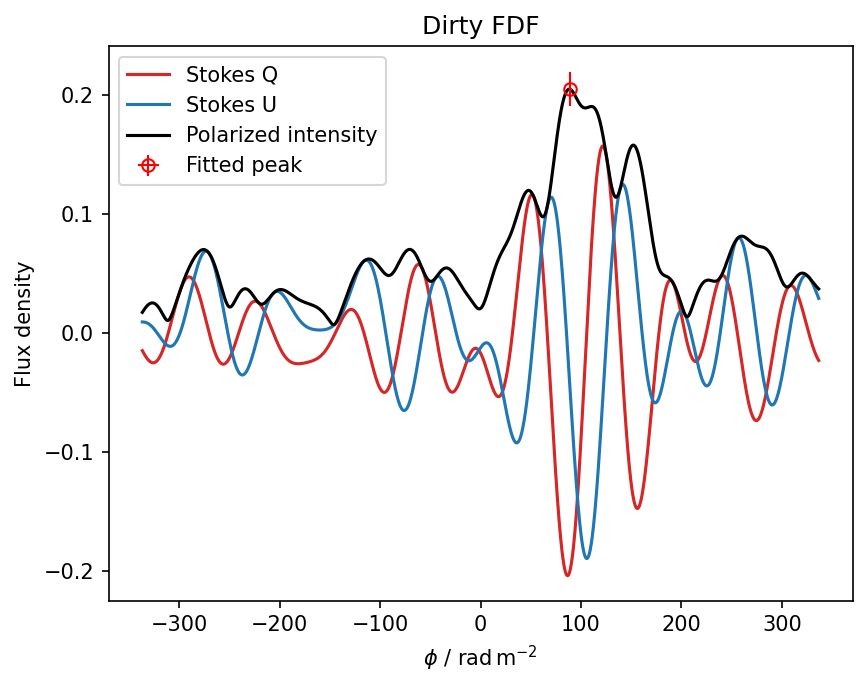
phi_arr_radm2 = fdf_arrs["phi_arr_radm2"].to_numpy()
fdf_dirty_arr = fdf_arrs["fdf_dirty_complex_arr"].to_numpy().astype(complex)

fig, ax = plt.subplots()

ax.plot(
    phi_arr_radm2,
    fdf_dirty_arr.real,
    color="tab:red",
    label="Stokes Q",
)
ax.plot(
    phi_arr_radm2,
    fdf_dirty_arr.imag,
    color="tab:blue",
    label="Stokes U",
)
ax.plot(
    phi_arr_radm2,
    np.abs(fdf_dirty_arr),
    color="k",
    label="Polarized intensity",
)

ax.errorbar(
    fdf_parameters["peak_rm_fit"],
    fdf_parameters["peak_pi_fit"],
    xerr=fdf_parameters["peak_rm_fit_error"],
    yerr=fdf_parameters["peak_pi_error"],
    fmt="o",
    lw=1,
    color="red",
    mfc="none",
    label="Fitted peak",
)

ax.set(
    xlabel=rf"$\phi$ / {u.rad / u.m**2:latex_inline}",
    ylabel="Flux density",
    title="Dirty FDF",
)
ax.legend()
[21]:
<matplotlib.legend.Legend at 0x7d13a9166060>
[22]:
phi2_arr_radm2 = rmsf_arrs["phi2_arr_radm2"].to_numpy()
rmsf_arr = rmsf_arrs["rmsf_complex_arr"].to_numpy().astype(complex)

fig, ax = plt.subplots()
ax.plot(
    phi2_arr_radm2,
    rmsf_arr.real,
    color="tab:red",
    label="Stokes Q",
)
ax.plot(
    phi2_arr_radm2,
    rmsf_arr.imag,
    color="tab:blue",
    label="Stokes U",
)
ax.plot(
    phi2_arr_radm2,
    np.abs(rmsf_arr),
    color="k",
    label="Polarized intensity",
)
ax.legend()
ax.set(
    xlabel=rf"$\phi$ / {u.rad / u.m**2:latex_inline}",
    ylabel="RMSF",
    title="RMSF",
)
[22]:
[Text(0.5, 0, '$\\phi$ / $\\mathrm{rad\\,m^{-2}}$'),
 Text(0, 0.5, 'RMSF'),
 Text(0.5, 1.0, 'RMSF')]